

Qatar Energy has provided a stark assessment of the damage inflicted by Iranian missile strikes on its Ras Laffan liquefied natural gas (LNG) facility, warning that repairs could take up to five years.
As one of the world’s leading suppliers of natural gas, Qatar earns billions annually from exports, particularly to Asian economies.
The company said on social platform X that the attacks reduced LNG exports by roughly 17% and are expected to cost about $20 billion per year in lost revenue. Production had already been halted following earlier strikes.
Providing an update on the damage from the missile attacks on Ras Laffan Industrial City
H.E. Minister Saad Sherida Al-Kaabi: The missile attacks reduced Qatar’s LNG export capacity by 17% and caused an estimated loss of $20 billion in annual revenue
– Extensive damage to our…
— QatarEnergy (@qatarenergy) March 19, 2026
A spate of attacks on critical oil and gas infrastructure across the Persian Gulf has heightened fears of prolonged global price volatility, affecting everything from gasoline and electricity to food and electronics.
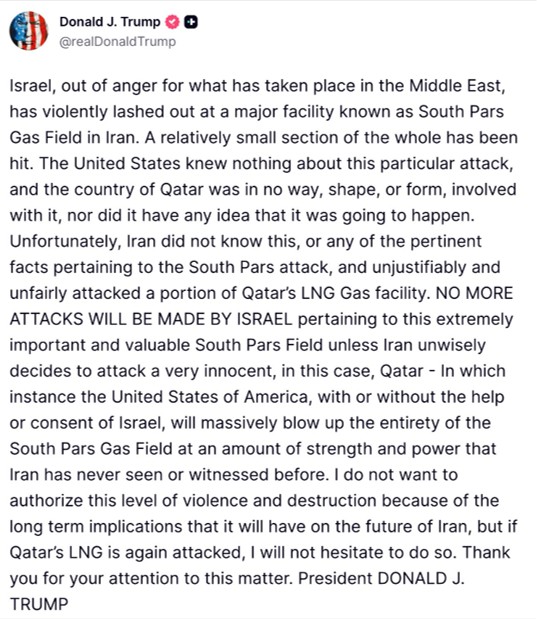
Trump Warns Against Any More Attacks on Qatar
U.S. President Donald Trump warned Israel against further attacks on South Pars and threatened retaliation if Iran targeted Qatar’s energy infrastructure.
Trump also distanced himself from Israeli strikes on Iran’s South Pars gas field, the largest reservoir of natural gas. At Trump’s urging, Israeli Prime Minister Benjamin Netanyahu has announced a halt to attacks on Iranian energy facilities.
Meanwhile, Tehran has virtually shut off the Strait of Hormuz, which carries at least 20% of global maritime oil trade.
Iran’s new Supreme Leader, Mojtaba Khamenei, described choking off the strait as a defensive measure against U.S. and Israeli actions.
Trump also spoke with the UAE’s leader amid attacks on its key energy and port facilities.
Iran’s Retaliation Against ME Neighbors
On Thursday, Iran carried out strikes on key Gulf energy sites in retaliation for an Israeli attack on the South Pars gas field, the world’s largest natural gas reserve shared with Qatar.
NOT ONE BUT TWO SEPARATE STRIKES ON RAS LAFFAN. QATAR PRODUCTION WHACKED. INDIA ON EDGE.
QatarEnergy Statement on Missile Attacks on its LNG Facilities:
“In addition to the previous attack on Ras Laffan Industrial City on Wednesday 18 March 2026 that resulted in extensive damage… pic.twitter.com/5WUA2IMryk— Rahul Shivshankar (@RShivshankar) March 19, 2026
The strikes have so far targeted Qatar’s Ras Laffan LNG terminal; Iran’s South Pars gas field and Kharg Island crude terminal; Saudi Arabia’s East-West pipeline and SAMREF refinery at Yanbu; the Fujairah oil terminal in the UAE; Kuwait’s Mina al-Ahmadi and Mina Abdullah refineries; Oman’s Port of Salalah LPG facility; and Abu Dhabi’s Shah gas field, which supplies gas and sulfur used in fertilizer, according to AP.
Saudi Arabia reported that a drone struck its SAMREF refinery in Yanbu, a joint venture between Saudi Aramco and ExxonMobil that processes more than 400,000 barrels per day of Arabian Light crude. The Saudi Defense Ministry said a damage assessment is underway. The strike extends Iran’s reach into Saudi assets along the Red Sea, where the kingdom has been exporting crude via pipeline to bypass the Strait of Hormuz, which remains under Iranian threat.
Energy Markets React Sharply
The closure of the Strait of Hormuz to international oil shipping, strikes on oil and gas sites, and a downturn in fuel production have compounded the energy situation, triggering a surge in oil prices and heightened market uncertainty.
Oil prices rose to $119 per barrel at one point on Thursday before falling back to around $92 per barrel.
Energy Site Attacks in Iran War Heighten Global Economic Risks
Several countries, including Pakistan, the Philippines, and Vietnam, have introduced energy austerity measures to cope with shortages. Shortages of other raw materials, such as helium for semiconductors and sulfur for fertilizer, could also drive prices higher throughout the supply chain.
The unfolding escalation underscores the vulnerability of global energy supplies and the potential for widespread economic consequences.
UN Security Council Holds Urgent Meeting on Energy Attacks
Bahrain’s U.N. Ambassador Jamal Alrowaiei, representing the Arab states on the Security Council, said the meeting was requested in response to ongoing “cowardly attacks by Iran” on Gulf countries, Jordan, and other nations.
Alrowaiei noted that many of the 15 council members emphasized the need for Iran to comply with a March 11 resolution calling for an immediate halt to attacks on Gulf countries and civilian infrastructure, including energy facilities. The resolution, adopted 13-0 with Russia and China abstaining, also demands that Iran stop actions or threats aimed at closing, obstructing, or interfering with navigation through the Strait of Hormuz, a critical waterway for 20% of global oil shipments.
EU Calls for Moratorium on Strikes Against Energy and Water Infrastructure
The European Union, which has already incurred billions of dollars in losses due to rising energy prices, has called for a “moratorium” on strikes against energy and water facilities amid the US-Israeli conflict with Iran.
“The European Council calls for de-escalation and maximum restraint, the protection of civilians and civilian infrastructure, and full respect for international law by all parties,” EU leaders said in conclusions adopted at a summit in Brussels.
They further condemned “any acts that threaten navigation or prevent vessels from entering and exiting the Strait of Hormuz,” while welcoming “the increased efforts announced by member states, including strengthened coordination with partners in the region, to ensure freedom of navigation in the Strait of Hormuz once conditions permit.”

Muhammad Luqman is Associate Editor at Views News Now. He writes on wide-ranging issues including economy, South Asia, the Middle East, agriculture, economy and innovation. Luqman has worked some of the leading news organizations and won acclaim for his original and research-based works.







