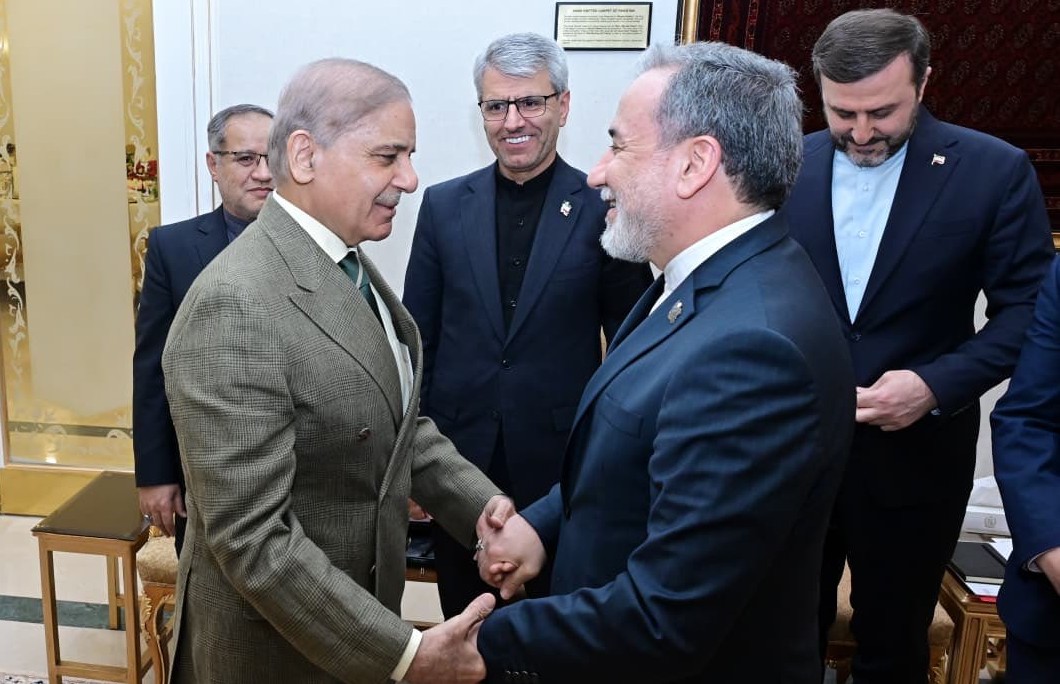
Iranian Foreign Minister Abbas Araghchi held extensive overnight meetings with Pakistan’s civilian and military leadership, as attention turns to Islamabad’s role in reviving stalled U.S.-Iran peace talks.
Araghchi’s visit, against the backdrop of continuing tensions in the Persian Gulf, underscores Islamabad’s position as one of the few countries trusted by both Washington and Tehran to act as a credible intermediary.
As the Iranian diplomat traveled to Pakistan, the White House said Donald Trump was dispatching his envoys Steve Witkoff and Jared Kushner for negotiations aimed at ending the conflict that erupted on February 28 and has since disrupted global trade through the blockaded Strait of Hormuz.
Was pleased to meet H.E. Seyed Abbas Araghchi, Foreign Minister of Iran, and his delegation in Islamabad today. Had a most warm, cordial exchange of views on the current regional situation. We also discussed matters of mutual interest, including the further strengthening of… pic.twitter.com/ZGLQNuGOK6
— Shehbaz Sharif (@CMShehbaz) April 25, 2026
The United States is awaiting Tehran’s response to Trump’s peace proposal, following recent public statements that point to persistently high tensions between the two sides.
Araghchi arrived late Friday night at Nur Khan Airbase in Rawalpindi, just outside Islamabad. His aircraft was escorted into Pakistani airspace by fighter jets—an honor reserved for visits of exceptional strategic significance.
He was received by Pakistan’s Deputy Prime Minister and Foreign Minister Ishaq Dar, Interior Minister Mohsin Naqvi, and Chief of Army Staff Field Marshal Asim Munir.
The high-level reception reflects Pakistan’s intensified diplomatic push after a planned second round of talks stalled, with Tehran yet to confirm participation.
President Trump has since extended the ceasefire to allow Iran—reportedly facing internal divisions over the proposed U.S. deal—more time to formulate a “unified” position.
Shortly after his arrival, Araghchi held closed-door talks with Munir and Dar. On Saturday, he met Prime Minister Shehbaz Sharif for further discussions on easing regional tensions that have disrupted energy supplies and trade flows across Asia, Europe and beyond.
Iran’s Position on Ceasefire and War’s End
Both Pakistani and Iranian officials remained tight-lipped about the substance of the talks.
However, Araghchi said he had conveyed Iran’s “principled positions” on the ceasefire and a complete end to what he described as an “imposed war.” In a post on his official Telegram account, he said he had outlined Tehran’s demands and concerns regarding U.S. proposals.
A working meeting was held today between the Foreign Minister of Iran and the Chief of Defense Forces of Pakistan, Field Marshal Asim Munir in Islamabad.
The People of Pakistan pray for a reliable and lasting peace in the Middle East and Iran. pic.twitter.com/E1hteh42IQ
— The STRATCOM Bureau (@OSPSF) April 25, 2026
An Iranian diplomatic source in Islamabad told Reuters that “principally, the Iranian side will not accept maximalist demands.”
Iran’s foreign ministry spokesperson also indicated that no direct meetings with U.S. officials are planned for now, with Tehran preferring to communicate through Pakistan as a mediator.
Cautious Optimism, Direct Talks Still Uncertain
Pakistan’s latest diplomatic efforts have generated cautious optimism, though progress remains uncertain after Iran declined to participate in earlier talks scheduled this week.
In Washington, the White House said Trump’s envoys Witkoff and Kushner would travel to Islamabad for a second round of discussions, though multiple reports suggest their arrival may be delayed until Sunday.
The White House has not provided further details.
Despite the flurry of diplomatic activity, Tehran has yet to commit to direct negotiations with Washington, maintaining that no face-to-face meetings are currently planned.
Broader Conflict: Oil, Nuclear Tensions and Economic Fallout
Beyond the diplomatic push, the conflict continues to reshape regional security and global markets.
The United States has enforced restrictions on Iranian shipping, while Iran has effectively constrained movement through the Strait of Hormuz—through which roughly one-fifth of global oil supply typically passes—heightening risks to international maritime traffic.
Energy prices have surged to multi-year highs, fueling inflation and clouding global economic prospects.
We arrive in Islamabad, Pakistan, for an official visit. FM Araghchi will be meeting with Pakistani high-level officials in concert with their ongoing mediation & good offices for ending American imposed war of aggression and the restitution of peace in our region.
No meeting… pic.twitter.com/1vP51xIoep
— Esmaeil Baqaei (@IRIMFA_SPOX) April 24, 2026
U.S. Defense Secretary Pete Hegseth said Iran still has “a chance to make a good deal,” adding that Tehran must abandon any pursuit of nuclear weapons in “meaningful and verifiable ways.”
Trump told Reuters that Iran was expected to present a proposal addressing U.S. concerns, though he declined to provide details, saying only that Washington was “dealing with the people that are in charge now.” He added that he was in “no rush” to finalize an agreement.
Araghchi’s Regional Tour Continues
After concluding his visit to Pakistan, Araghchi is expected to travel to Oman and Russia—countries that have previously played roles in mediation between Iran and the United States.
However, his exact departure time from Islamabad has not been confirmed.
While no formal breakthroughs have emerged from the talks so far, the pace of diplomacy in Islamabad suggests back-channel engagement remains active.
With U.S. envoys expected to arrive shortly, the coming days are likely to determine whether the fragile ceasefire evolves into a broader political settlement or whether tensions persist across the region.

Kiran Asim is a writer who covers the U.S., Europe, South Asia, and the Middle East. Her reports and analyses look at the geostrategic issues and contemporary developments and their economic and political implications. She also writes about society and education.

Muhammad Luqman is Associate Editor at Views News Now. He writes on wide-ranging issues including economy, South Asia, the Middle East, agriculture, economy and innovation. Luqman has worked some of the leading news organizations and won acclaim for his original and research-based works.

Asim Tanveer is a seasoned journalist working for TV and electronic and print media outlets. He has been working for some of the world’s leading news organizations including Associated Press (AP), Reuters, BBC, CNN, CNBC, Star TV, Voice of America and The New York Times for more than 20 years. He has won several awards for his live coverage of events that include a Reuters News Agency World Award and the Pride of Performance award in 2010.