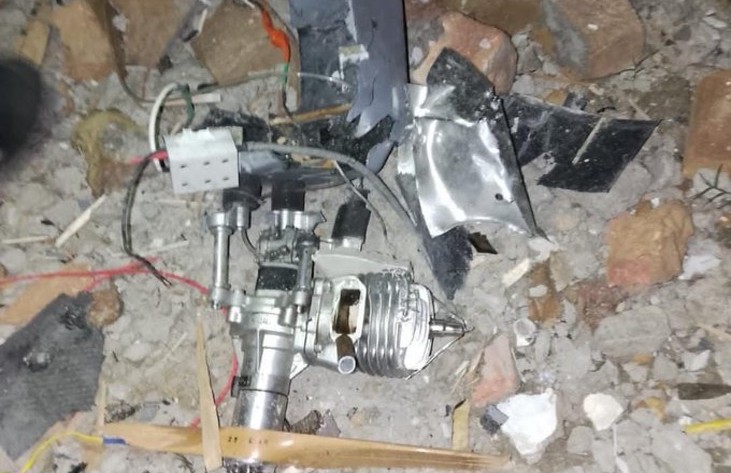
Pakistan blasted the Afghan Taliban regime Friday following a drone incursion near the strategic hub of Rawalpindi, which serves as military headquarters of the country’s armed forces.
While the physical threat was neutralized, the incident enflamed a fierce diplomatic and digital skirmish over the Taliban propaganda and origin and intent of the hardware.
The incident occurred as Islamabad continued its campaign to strike militant targets in Afghanistan that Islamabad says serve as a base for attacks against Pakistani civilians and security forces.
Security sources confirmed that two “rudimentary” drones were detected and intercepted at different locations adjacent to Rawalpindi, outside capital Islamabad. Rather than using traditional kinetic force, Pakistani security forces reportedly employed electronic countermeasures to bring the craft down.
🔎 Fact Check | Ministry of Information & Broadcasting
✅ Reality
◼️Two rudimentary drones of terrorist FAK,nurtured by Afghan Taliban regime, were successfully intercepted by the Pakistan security forces using electronic counter measures. No military or other infrastructure was… pic.twitter.com/aGfJEAq0XL— Fact Checker MoIB (@FactCheckerMoIB) March 13, 2026
While the Pakistan Airports Authority (PAA) briefly caused confusion with a deleted post regarding “operational adjustments” at Islamabad International Airport, officials later clarified that the airspace remains fully operational.
No casualties or significant infrastructure damage were reported, though minor damage occurred due to falling debris from the forced crashes.
The incident quickly shifted from a tactical security matter to a geopolitical blame game. The Afghan Ministry of Defense claimed on X (formerly Twitter) that the drones had successfully targeted a military center in Faizabad, alleging significant “loss of human lives and material.”
Having lost their Corps HQ, Brigade HQ, multiple posts, and armored assets, the Kharji TTA regime appears increasingly desperate. After failed attempts with rudimentary drones neutralized electronically, they have now turned to coordinated misinformation, amplified by Indian… pic.twitter.com/rXfkSPjBpM
— Sajawal Rana (@Saju__302) March 13, 2026
Pakistan’s Ministry of Information issued a blistering rebuttal, dismissing the Afghan claims as “frivolous” and “fake news.” The Ministry characterized the drones as tools of Fitna-al-Khawarij—the state’s designation for the banned Tehreek-i-Taliban Pakistan (TTP)—and accused the Afghan Taliban of “nurturing” these elements.
In a notable hardening of rhetoric, the information ministry’s statement linked the Taliban regime to a broader proxy war, using specific terminology to categorize the threats:
Islamabad’s stance is clear: they view the Taliban regime not just as a neighbor failing to police its borders, but as a “master proxy” supporting groups that Pakistan alleges are backed by Indian interests.
This is not the first time the two nations have clashed in the digital sphere. The Ministry of Information pointed to a history of “unverifiable evidence” from Kabul, citing past instances where Afghan officials claimed to have shot down Pakistan Air Force aircraft—claims that were later deleted without explanation.
Footage of Pakistan Airforce jet shooting down the drones in Islamabad 🇵🇰
India recently delivered drones to Afghan Taliban.
Pakistan fighting against the Indian proxies sitting inside Afghanistan. pic.twitter.com/9tyGZYAS0R— Raja Faisal (@RajaFaisalPK) March 13, 2026
Despite the initial confusion regarding the closure of Islamabad’s airspace, the PAA has urged the public to ignore “unverified or misleading reports” and rely solely on official channels.
For now, the physical drones are down, but the high-altitude friction between Islamabad and Kabul shows no signs of descending amid Pakistan’s ongoing counterterrorism strikes against militant sites in Afghanistan.
Earlier, as a Reuters report, a Pakistani airstrike targeted a fuel depot of private airline Kam Air near Afghanistan’s Kandahar airport.

Kiran Asim is a writer who covers the U.S., Europe, South Asia, and the Middle East. Her reports and analyses look at the geostrategic issues and contemporary developments and their economic and political implications. She also writes about society and education.