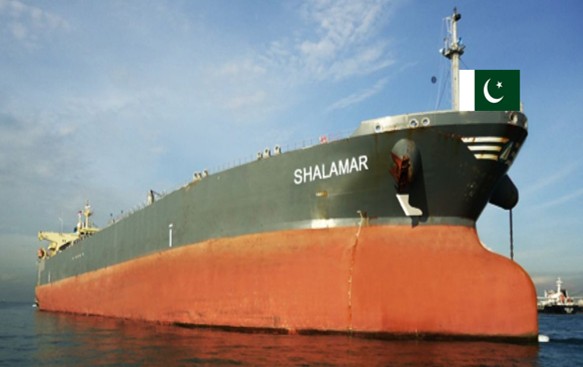
A Pakistan-flagged oil tanker has become the first vessel to transit the Strait of Hormuz since heightened restrictions disrupted shipping this week, marking a tentative breakthrough along one of the world’s most critical energy routes.
The crude oil tanker Shalamar cleared the strategic waterway carrying approximately 450,000 barrels of oil loaded from the United Arab Emirates, according to marine traffic data cited by Stratcom Bureau.
The vessel sailed south of Iran’s Larak Island before entering the Gulf of Oman, completing a rare passage at a time of heightened regional tensions due partly to Iran’s restrictions and the U.S. blockade on Iranian ports.
Tracking data indicated that the tanker moved through international waters accompanied by Pakistani naval vessels. There has been no independent confirmation from U.S. or regional authorities regarding the extent of coordination or security arrangements involved.
Marine traffic data shows that the Pakistani-flagged crude oil tanker Shalamar cleared the Strait of Hormuz carrying crude oil loaded from the United Arab Emirates. The vessel also passed the U.S. Navy blockade accompanied by the Pakistan Navy in international waters. https://t.co/DnmOxiglOs pic.twitter.com/6284yVccCB
— The STRATCOM Bureau (@OSPSF) April 17, 2026
The transit comes after several days of sharply reduced maritime traffic following what has been described as a U.S.-led effort to restrict access to routes linked to Iranian ports. The scope and enforcement of those restrictions have not been fully detailed publicly.
In a significant development on Friday, Iran announced that the Strait of Hormuz has been reopened to all commercial shipping following a ceasefire between Israel and Lebanon, a move that could signal a broader de-escalation across the region.
U.S. President Donald Trump welcomed the reopening but said American forces would continue enforcing restrictions on Iranian-linked vessels until a comprehensive agreement is reached with Tehran. The parallel positions highlight the fluid and uncertain nature of the current security environment in the waterway.
The easing of tensions had an immediate impact on global energy markets, with oil prices retreating from highs reached during the conflict as concerns over supply disruptions through the strait began to subside.
Trump Thanks Pakistan as US-Iran Talks Show Signs of Progress
In parallel, Pakistan stepped up its diplomatic engagement across the region, with Prime Minister Shehbaz Sharif and its military chief Asim Munir holding separate high-level contacts with officials in Iran, Saudi Arabia, Qatar and Turkey. The outreach, spanning bilateral visits and multilateral forums, was aimed at building consensus among key regional stakeholders and reinforcing momentum toward a potential U.S.-Iran agreement.
The developments coincide with intensified diplomatic efforts involving Pakistan, which has emerged as a key intermediary in ongoing U.S.-Iran engagement, after the war erupted on February 28 with the U.S. and Israeli coordinated attacks on Iran and Tehran’s regionwide retaliatory strike that engulfed the entire Middle East in the conflict.
On Thursday, President Trump said he may visit Pakistan if progress is made in the next round of talks between Washington and Tehran, expected to take place in Islamabad in the coming days.
Analysts caution that while the Shalamar’s passage and Iran’s reopening announcement may point to a shift toward stabilizing the overall environment, conditions in and around the Strait of Hormuz remain fragile.
However, sustained normalization of shipping traffic is likely to depend on agreements on maritime security and broader geopolitical issues, including Iran’s nuclear program.

Muhammad Luqman is Associate Editor at Views News Now. He writes on wide-ranging issues including economy, South Asia, the Middle East, agriculture, economy and innovation. Luqman has worked some of the leading news organizations and won acclaim for his original and research-based works.