With Washington and Tehran showing little willingness to soften their positions, Pakistan has renewed its diplomatic engagement in an effort to preserve the fading prospects of a negotiated settlement.
Islamabad has dispatched its Interior Minister as envoy for an unannounced visit to Tehran as concerns over regional security, maritime stability, and the risk of broader confrontation continue to weigh on the Gulf and dampen global trade prospects.
Pakistan had hosted the first round of talks between the United States and Iran in April, but since then the peace process has remained stalled and, in President Donald Trump’s words, is now on “life support.”
Back from a trip to China, Trump faces a difficult strategic choice: whether to revive negotiations or escalate toward a military option.
Meanwhile, Tehran has sought to assert greater control over the Strait of Hormuz, even as it continues to feel pressure from heightened U.S. naval presence in the region.
Pakistan’s renewed diplomatic engagement is significant, coming amid repeated acknowledgements from both Washington and Tehran of Islamabad’s role as a trusted intermediary.
Interior Minister in Tehran, Again
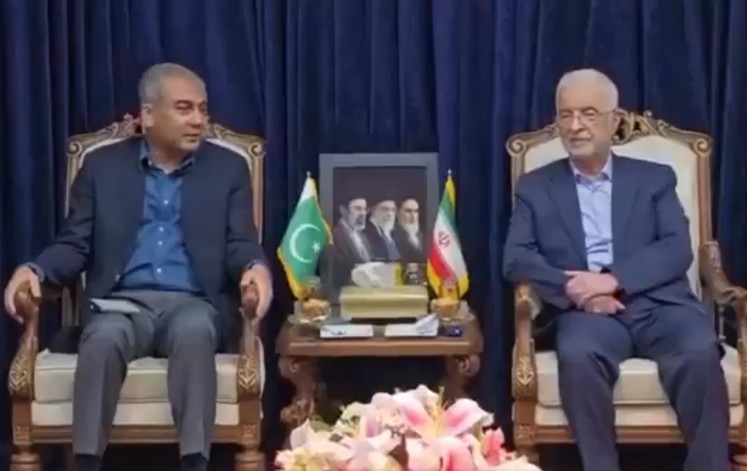
As part of this renewed initiative, Pakistan’s Interior Minister Mohsin Naqvi has arrived in Tehran on a two-day visit, widely viewed by diplomatic observers as a continuation of Islamabad’s mediation efforts aimed at preventing a complete breakdown of the peace process.
Naqvi had also accompanied Pakistan’s Army Chief General Asim Munir during a visit to Tehran last month, when Pakistani officials spent several days engaged in intensive discussions aimed at reviving dialogue and averting a potential military escalation between Washington and Tehran.
Pakistan Interior Minister Mohsin Naqvi is in Iran for a two day unannounced visit – he was earlier in Tehran some weeks ago when he accompanied Pakistan Army Chief Gen Asim Munir on the latter’s visit in mid-April pic.twitter.com/5cQrtDXRO0
— omar r quraishi (@omar_quraishi) May 16, 2026
Although Pakistani officials have formally framed the visit around bilateral cooperation and border management, regional diplomatic sources suggest it also forms part of a broader effort to maintain momentum in fragile negotiations after earlier rounds of engagement lost traction in recent weeks.
The diplomatic push comes at a sensitive moment, as a fragile ceasefire — reportedly facilitated in part through Pakistani mediation — continues to hold unevenly amid recurring tensions near the Strait of Hormuz and ongoing disruptions to global energy shipping routes.
Tehran Meetings Focus on Regional Stability
During his stay in Tehran, Naqvi, seen as a tusted interlocutor of Army Chief General Asim Munir, is expected to hold discussions with senior Iranian officials, including Interior Minister Eskandar Momeni.
The talks are likely to focus on bilateral security coordination as well as broader regional developments linked to the trajectory of US-Iran negotiations, though the two sides have avoided framing it as a diplomatic push toward revival of talks.
Pakistani FM: 20 Iranian sailors to be transferred to Islamabad Friday nighthttps://t.co/EL3TJeDNrD pic.twitter.com/T1n2h3KaKs
— IRNA News Agency ☫ (@IrnaEnglish) May 15, 2026
The visit also follows closely on the heels of President Trump’s recent trip to China, where he met Chinese President Xi Jinping. Despite speculation that Beijing might quietly encourage Tehran toward compromise, the meeting produced no visible breakthrough on the Iran file.
Trump Maintains Pressure with Limited Flexibility
Analysts noted that President Trump returned from Beijing continuing to emphasize pressure tactics while simultaneously signaling limited flexibility on Iran’s uranium enrichment program.
Speaking aboard Air Force One, Trump suggested he could support a 20-year suspension of Iran’s enrichment activities if Tehran provided what he described as a “real guarantee” — a position seen as softer than his earlier insistence on the permanent dismantlement of Iran’s nuclear infrastructure.
U.S. President Donald Trump on Iran:
“I’m going to do what’s right. I have to do what’s right. The Strait will be opened, they will not have a nuclear weapon, and the world will go on. You will see gasoline prices drop, energy prices generally drop.”
Contributed by @AZ_Intel_. pic.twitter.com/yeQmuRfkqY
— Open Source Intel (@Osint613) May 15, 2026
At the same time, Trump sharply criticized Iran’s latest proposal, accusing Tehran of retreating from earlier understandings on highly enriched uranium stockpiles.
The continuing deadlock has reinforced concerns among diplomats that negotiations may be entering a prolonged phase marked by simultaneous diplomacy and coercive pressure, rather than movement toward a comprehensive settlement.
Tehran Cites Lingering Distrust
According to Iranian media reports, recent US and Israeli strikes caused widespread casualties and significant infrastructure damage in Tehran. Iranian officials said at least 1,260 people were killed and more than 2,800 injured.
Municipal authorities also reported damage to approximately 51,000 residential units, along with thousands of vehicles and other civilian assets.
The prevailing assessment inside Iran is that President Trump may resort to restarting military action, and Tehran is now deliberately pursuing a strategy of “deception and delay” with the hopes that buying time will complicate any potential return to war,” two regional… pic.twitter.com/dcjcQW1dGN
— Imtiaz Mahmood (@ImtiazMadmood) May 17, 202
In an interview with Al Jazeera, Iranian Foreign Minister Abbas Araghchi said contradictory American statements had severely undermined Tehran’s confidence in Washington’s intentions.
“The most important question right now is the question of trust. We cannot trust Americans at all,” Araghchi said.
He stressed that all components of any future agreement would need to be defined “very clearly” before a deal could be finalized, adding that objectives unattainable through military force could not be achieved through diplomacy unless both sides embraced a mutually beneficial framework.
‘Iran Has an Interest in a Deal’
Despite escalating rhetoric, President Trump maintained that Tehran still had “an interest in reaching an agreement” on both its nuclear program and the broader regional conflict, while reiterating that Iran must renounce uranium enrichment under any final settlement.
In a telephone interview with French broadcaster BFMTV, Trump acknowledged uncertainty over the prospects for a breakthrough.
Trump on Iran:
We really did the ceasefire at the request of other nations.
I wouldn’t have really been in favor of it, but we did it as a favor to Pakistan — terrific people, the field marshal and the prime minister. pic.twitter.com/Bsa3AqpcNl
— Clash Report (@clashreport) May 15, 2026
“I have no idea. If they don’t, they’re going to have a very bad time. They have an interest in reaching an agreement,” he said.
Regional Powers Continue Diplomatic Engagement
Separately, Russian President Vladimir Putin discussed the Iran crisis with UAE President Sheikh Mohammed bin Zayed Al Nahyan, according to a Kremlin statement issued on Saturday.
The statement emphasized the importance of sustaining political and diplomatic efforts aimed at achieving compromise-based peace arrangements.
Meanwhile, Qatar has also issued fresh calls for the resumption of US-Iran negotiations, urging all sides to return to dialogue in order to reach a negotiated settlement of the conflict.
What Pakistan Really Gained from Hosting US-Iran Talks https://t.co/PtjaTYOjcY via @ViewsNewsNow #Pakistan #diplomacy #US #IranWar #Talks
— Views&News (@ViewsNewsMag) April 13, 2026
A UAE-based news agency WANA reported that Iran had formally communicated its latest negotiating positions to Pakistan after receiving revised American conditions through Islamabad’s mediation channel.
The development came despite Trump’s public assertion last week that he had rejected Iran’s proposal without reviewing it. Subsequent reports, however, suggested Washington nevertheless transmitted an official response to Tehran via Pakistani intermediaries.
Diplomacy Persists Despite Risks of Escalation
Although earlier reports suggested the United States had outright dismissed Iran’s proposal, more recent accounts indicate that diplomatic communications between Tehran and Washington remain active, with both sides continuing to exchange messages aimed at reaching a memorandum of understanding that could reduce tensions and prevent further escalation.
Diplomatic sources confirmed that communication channels remain open, with negotiations continuing over specific clauses within the evolving framework.
The mediation initiative — reportedly launched in April — has centered on successive revisions to Iran’s original 14-point negotiation proposal.
Observers caution that while ongoing diplomatic exchanges do not eliminate the possibility of renewed military confrontation, they nevertheless underscore that diplomacy remains alive and that all parties continue to explore a negotiated path toward de-escalation and regional stability.

Muhammad Luqman is Associate Editor at Views News Now. He writes on wide-ranging issues including economy, South Asia, the Middle East, agriculture, economy and innovation. Luqman has worked some of the leading news organizations and won acclaim for his original and research-based works.