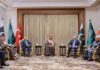
Pakistan on Sunday confirmed it had received Iran’s formal response to a United States proposal outlining a framework for potential talks aimed at ending the conflict, as Pakistani leaders expressed gratitude to both Washington and Tehran for entrusting Islamabad with a central mediation role.
“The leadership of the United States of America and the Islamic Republic of Iran, especially President Donald Trump, are highly appreciated for placing their trust in Pakistan for this difficult task,” Chief of Army Staff Field Marshal Asim Munir said.
He added that Pakistan remained “fully committed” to supporting diplomatic efforts, stressing that the country would continue to engage “with sincerity and dedication” to advance the peace initiative.
His remarks came hours before Iran’s response was formally conveyed to Pakistani intermediaries for onward transmission to Washington.
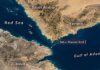
U.S. President Donald Trump has previously acknowledged Pakistan’s role in regional diplomacy, praising efforts led by Prime Minister Shehbaz Sharif and Field Marshal Munir, particularly in easing tensions linked to disruptions in the Strait of Hormuz and facilitating indirect communication between the two sides.
If any attempt is made again to engage in adventurism against Pakistan, this time the response will not be limited, but extremely extensive, dangerous, far-reaching, and painful.: Pakistan Field Marshal General Asim Munir pic.twitter.com/IZo56JJ0zi
— Waseem Abbasi (@Wabbasi007) May 10, 2026
The developments come as Pakistan continues to position itself as a key intermediary in efforts to stabilize regional tensions, even as broader geopolitical and security dynamics remain fluid.
Commemorations of Defense Against Indian Aggression
Field Marshal Munir’s statement was delivered on the same day Pakistan marked the anniversary of what it describes as its response to Indian military escalation in May 2025.
Speaking at General Headquarters in Rawalpindi, the army chief described the occasion as a moment of “national pride and reflection,” as senior military leadership gathered to commemorate what Islamabad refers to as “Marka-i-Haq” (Battle of Truth). The ceremony was attended by Air Chief Marshal Zaheer Ahmed Babar Sidhu and Admiral Naveed Ashraf, with wreath-laying ceremonies held at the Martyrs’ Monument followed by a military salute and national anthem.
Prime Minister Muhammad Shehbaz Sharif’s message on the occasion of one year since the Victory of Marka-e-Haq & Operation #BunyanUmMarsoos
“The whole nation is with the #Pakistan Armed Forces under the leadership of Field Marshal Syed Asim Munir #COAS & CDF.” PM#ISPR pic.twitter.com/X9rHP1oi9Y
— Pakistan Armed Forces News 🇵🇰 (@PakistanFauj) May 10, 2026
In coordinated statements, Pakistan’s service chiefs described the anniversary as a moment of “deep reverence, gratitude and national resolve.”
Narrative on Conflict and Strategic Posture
Recounting last year’s hostilities, Munir referenced the April 22, 2025 Pahalgam attack and subsequent escalation, which culminated in May 10 following what Pakistan calls Operation Bunyanum Marsoos. He said India had violated Pakistani sovereignty between May 6 and May 10, before facing what he described as “full national unity and military response.”
On May 10, the world watched the conflict between the two South Asian nuclear powers nervously, President Trump announced the two sides had agreed to a ceasefire.
In his remarks, Munir characterized the confrontation as more than a conventional conflict, framing it as a “contest of ideologies” in which, he said, Pakistan’s position prevailed. He also reiterated longstanding Pakistani allegations regarding previous regional crises, while accusing India of pursuing destabilizing narratives—claims New Delhi has consistently rejected.
Asim Munir said Pakistan’s armed forces had demonstrated operational readiness during the conflict, including what he described as one of the most sustained air engagements in recent years.
Military Modernization and Strategic Developments
The army chief highlighted recent defense and security reforms, including the establishment of new command structures, expansion of space capabilities, and acquisition of advanced military platforms such as submarines, fighter aircraft, and missile systems. He said these developments reflected a broader shift in doctrine, training, and research.
He also pointed to Pakistan’s evolving international partnerships, including a Strategic Mutual Defense Agreement with Saudi Arabia, as evidence of strengthening defense ties.
Regional Security and Kashmir Position
Asim Munir accused India of increasing what he described as “state-sponsored terrorism” and alleged cross-border militant activity, including through Afghanistan. He urged Afghan authorities to dismantle alleged safe havens and praised Pakistani security forces and civilians in Khyber Pakhtunkhwa and Balochistan for their role in counterterrorism efforts over two decades.
Reiterating Pakistan’s longstanding position, he said the Kashmir dispute remains central to regional peace, stressing that its resolution must align with United Nations resolutions and the aspirations of the Kashmiri people.

Asim Tanveer is a seasoned journalist working for TV and electronic and print media outlets. He has been working for some of the world’s leading news organizations including Associated Press (AP), Reuters, BBC, CNN, CNBC, Star TV, Voice of America and The New York Times for more than 30 years. He has won several awards for his live coverage of events that include a Reuters News Agency World Award and the Pride of Performance award in 1997.