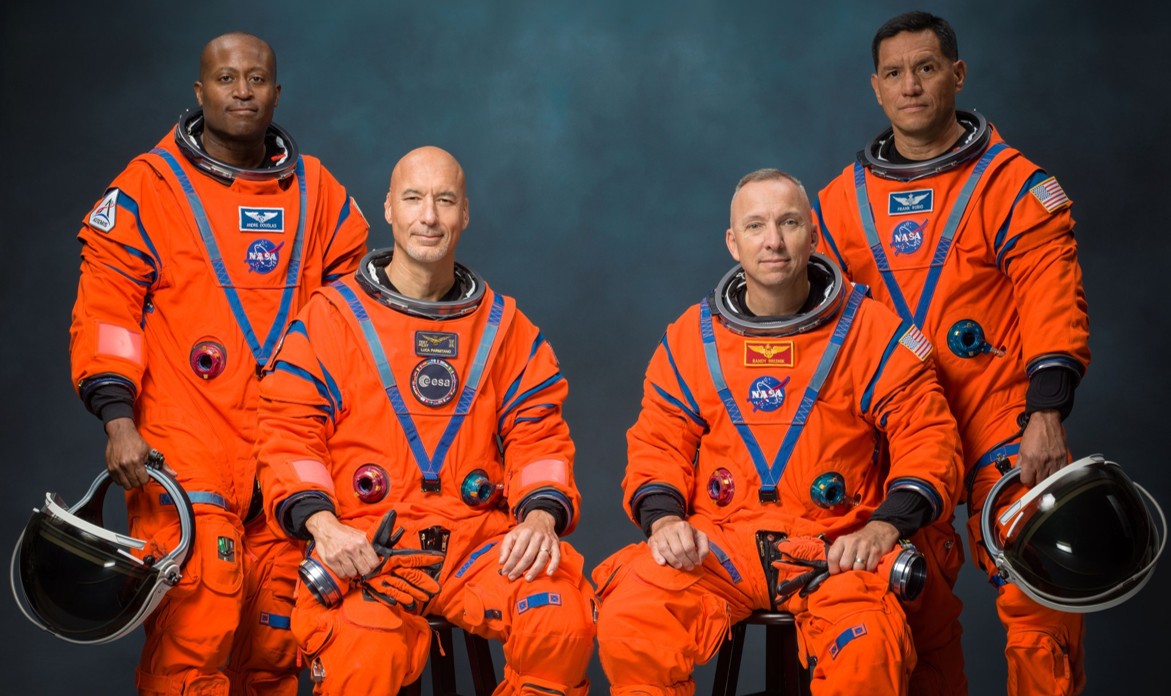
U.S. space agency NASA has named the four astronauts who will strap into the Orion spacecraft for the highly anticipated Artemis III mission—a high-wire act of orbital choreography slated for 2027.
While this crew won’t walk on the lunar surface, their mission is arguably one of the most complex test flights in a generation.
Meet the team: Veteran NASA astronaut Randy Bresnik (commander), ESA’s Luca Parmitano (pilot), and mission specialists Andre Douglas and Frank Rubio. (NASA’s Bob Hines has also been named as the backup.)
So, what exactly are they doing? Unlike the Apollo era, Artemis III isn’t a direct shot to the Moon. Instead, it’s a cosmic dance of docking, undocking, and testing that will take place right above our heads in low-Earth orbit.
I was excited for today…excited to cheer on the Agency and my friends as we named the Artemis III crew.
What I didn’t expect was the feeling of complete, unbridled happiness in my soul as @Astro_Jeremy (from afar), @Astro_Christina, @AstroVicGlover and I ceremonially handed… pic.twitter.com/PV14YSYTAe
— Reid Wiseman (@astro_reid) June 9, 2026
Here is the plan: The SLS rocket will launch the Orion crew into orbit. Then, the real show begins. They will play a game of “orbital tag” with test versions of the massive human landing systems built by commercial partners Blue Origin and SpaceX. First, they will rendezvous with Blue Origin’s lander, then later detach and link up with SpaceX’s Starship pathfinder.
“This mission will require the most awe-inspiring coordination of heavy-lift rocket launches in history,” said NASA Administrator Jared Isaacman. “They are ushering in a new Golden Age of exploration.”
For Parmitano, the assignment carries extra weight: he is the first European Space Agency astronaut ever named to an Artemis mission. “Europeans can take pride in being part of this exciting journey,” said ESA Director General Josef Aschbacher.
Get ready for Earth joy!
Earlier today, we announced the four astronauts who will go to space on Artemis III —and shared the latest updates on the future of @NASAArtemis.
Learn more about how this mission will set us up to return humanity to the Moon: https://t.co/kAvzvuYzEw pic.twitter.com/taD2lCdYiC— NASA (@NASA) June 10, 2026
The crew is already packing their bags for training. Leading the charge is Randy Bresnik, a retired Marine colonel with 7,000 flight hours. Luca Parmitano—famous for surviving a helmet water leak during a spacewalk in 2013—will serve as pilot.
Frank Rubio brings the grit; he currently holds the American record for the longest single spaceflight (371 days). And Andre Douglas, the rookie of the group, is a former Coast Guard officer with four postgraduate degrees.
The mission is a necessary detour. While Artemis IV (planned for 2028) will land humans at the lunar South Pole, Artemis III is the ultimate test drive. Engineers need to verify that Orion can talk to the commercial landers, manage the software, and survive the docking maneuvers.
The crew will spend about two weeks in space, they won’t be landing on the Moon just yet. But as Bresnik and his crew begin training immediately, one thing is clear: The countdown to humanity’s permanent return to deep space has officially begun.

Huma Nisar is Associate Editor at Views News Now. She also writes opinion articles on health, society and diet.