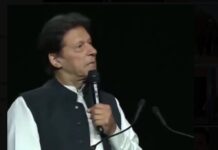
Indian Prime Minister Narendra Modi made a stark threat to the people of Pakistan, warning they would face his bullets if they do not choose peace with India.
Speaking at a rally at Bhuj town in his home state of Gujarat, Modi made the threat in a sign of frustration in the backdrop of setbacks his country suffered in confrontations with Pakistan.
Although, India and Pakistan engage in rhetoric, Modi’s language, was seen in Pakistan as highly inappropriate and provocative for a head of government, especially when directed at citizens of another country.
“To rid Pakistan of the disease of terrorism, the people of Pakistan must step forward. The youth of Pakistan must come forward. Live a life of peace, eat your bread in comfort, or else, my bullet is there (… sukh chain ki zindagi jiyo, roti khao, warna meri goli to hai hi…).”
The Indian news agency ANI released a video of Modi’s statement, which immediately drew condemnation from Pakistani analysts and media anchors.
Islamabad condemned the remarks towards Pakistan a “reckless provocation”.
The developments follow a recent military confrontation between India and Pakistan over New Delhi’s allegations against Islamabad that a terror attack in Indian-controlled Kashmir’s Pahalgam was linked to a Pakistani militant group, Laskar-e-Taiba.
The attack killed 26 people on April 22, and New Delhi said Pakistan has not done enough to control militant groups form targeting India.
On the night of May 6-7, New Delhi launched a series of air strikes in Pakistan, resulting in civilian casualties. Islamabad responded by downing five Indian jets.
After intercepting drones sent by India and tit-for-tat strikes on each other’s airbases, it took U.S. President Donald Trump’s diplomatic intervention on May 10 for both sides to finally silence their guns as a ceasefire was reached.
Modi said in the speech, “The people of Pakistan must come forward to rid their country of terrorism. Their youth will have to come forward.”
India has long accused Pakistan of perpetrating terror on its soil.
Pakistan has also accused Indian of sponsoring terrorism in Balochistan and Khyber Pakhtunkhwa through its proxies including Baloch Liberation Army and Tehreek-e-Taliban Pakistan.
He went on to say: “Live a life of peace, eat your bread or [choose my] bullet,” to applause from the crowd, with many adorned in orange and white outfits.
Pakistan’s Foreign Office issued a statement, saying it has taken note of Modi’s remarks “delivered in Gujarat with the theatrical flourish of a campaign rally rather than the sobriety expected of the leader of a nuclear-armed state.
“The hate-driven invocation of violence in his remarks is deeply disturbing, not only for its content but for the dangerous precedent it sets in region already burdened by volatility,” the FO said
“We regret the continued erosion of maturity and decorum in Indian statecraft.”
The FO noted that such statement “blatantly violate” the fundamental principles of the United Nations Charter, which obliges member states to resolve disputes peacefully and to refrain from the threat or use of force against the sovereignty or political independence of other states.
“Pakistan views these remarks as a reckless provocation, intended to distract from the ongoing human rights abuses and demographic engineering in Indian Illegally Occupied Jammu and Kashmir,” the statement said.
“If extremism is indeed a concern for the Indian government, it would do well to turn inward-toward the alarming rise of majoritarianism, religious intolerance, and the systematic disenfranchisement of minorities under the increasingly brutal Hindutva ideology,” the Foreign Ministry said.
India has not yet commented officially on the controversy sparked by Modi’s remarks.
In the past Indian analysts have linked such statements to internal Indian politics, especially when the country goes to polls.

Muhammad Luqman is Associate Editor at Views News Now. He writes on wide-ranging issues including economy, South Asia, the Middle East, agriculture, economy and innovation. Luqman has worked some of the leading news organizations and won acclaim for his original and research-based works.