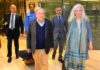
The United States and Pakistan celebrated a milestone in cultural ties in Islamabad as U.S. Embassy Chargé d’affaires Natalie A. Baker and Minister of State for Education Wajiha Qamar officially opened the new purpose-built home that will house the United States Educational Foundation in Pakistan (USEFP).
The inauguration comes at a meaningful moment—75 years of the Fulbright program in Pakistan.
Established in 1950, USEFP is one of 49 Fulbright Commissions worldwide and a cornerstone of U.S.-Pakistan educational cooperation.
Over the decades, more than 9,000 Pakistanis and nearly 1,000 Americans have participated in USEFP exchange programs—strengthening academic ties, fostering mutual understanding, and building lasting connections between the two countries.

Speaking at the ceremony, CDA Baker noted that as the United States approaches its 250th anniversary in 2026, the new USEFP building stands as a powerful symbol of America’s founding ideals and of the shared commitment both nations hold toward advancing education and opportunity.
The impressive five-story, 9,755-square-meter facility is designed to be a dynamic hub for learning, innovation, and exchange.
It brings together EducationUSA advising services, a Lincoln Corner, dedicated training spaces, and a range of public programs—all under one roof.
This integrated space will give students, educators, and community members expanded access to resources that can open doors around the world and help equip Pakistan’s youth with the skills needed in a global economy.

The ribbon-cutting was attended by an array of distinguished guests, including U.S. Department of State Principal Deputy Assistant Secretary for Educational and Cultural Affairs Sherry Keneson-HHall; Acting Deputy Assistant Secretary for South and Central Asian Affairs Shelly Seaver; USEFP Executive Director Peter Moran; USEFP Chair Kamal Uddin Tipu; artist and poet Dr. Raja Changez Sultan; and leaders from Pakistan’s academic and government sectors.
In her remarks, CDA Baker emphasized that the building represents far more than bricks and mortar.
“This is more than a building. It is a symbol of the deep commitment both the United States and Pakistan have to education, innovation, and building a safe, stronger, more prosperous future together.
“It will also be used as a public space for Pakistanis to learn more about the United States and a place where people can come to exchange ideas on issues that affect us all,” she said.

Kiran Asim is a writer who covers the U.S., Europe, South Asia, and the Middle East. Her reports and analyses look at the geostrategic issues and contemporary developments and their economic and political implications. She also writes about society and education.