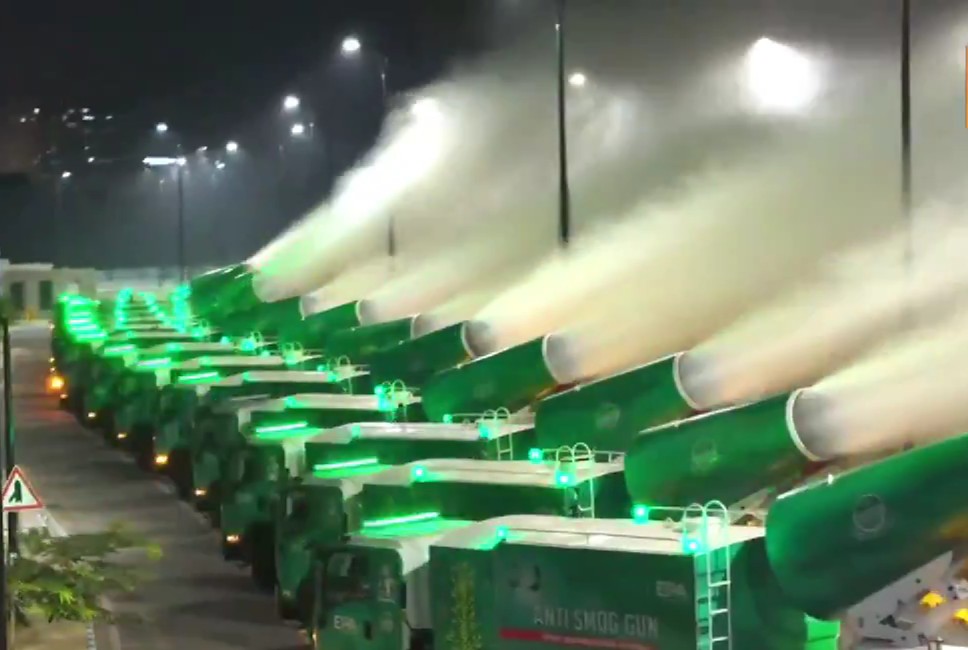
Pakistan has launched a large-scale “anti-smog gun” operation in Lahore, one of the world’s most polluted cities – raising hope in the battle against pollution.
The initiative, led by the Punjab government, involves the use of specialized vehicles spraying fine water mist over roads and industrial zones to settle dust and particulate matter that contributes to the city’s toxic smog.
According to Punjab’s Senior Minister Marriyum Aurangzeb, the first deployment on Saturday led to a sharp drop in Lahore’s Air Quality Index (AQI) — from a hazardous 666 to a moderate 170.
“This 70 percent decrease in air pollution has been scientifically analyzed and confirmed by our advanced environmental monitoring system,” Aurangzeb said in a video message posted on social media platform X (formerly Twitter).
CM Punjab Maryam Nawaz ‘s Smog less Punjab vision , for the first time in Punjab’s history, air quality forecasting has been used to guide timely operations under an all-of-government strategy, keeping AQI levels under control as forecasted Alhamdulillah.
With modern technology,… pic.twitter.com/AN95rl5BXy
— Marriyum Aurangzeb (@Marriyum_A) October 19, 2025
“Our commitment to using modern technology to combat smog and protect citizens’ health remains unwavering.”
The Fifth Season: Smog in Lahore
Every winter, smog blankets Lahore in a thick toxic haze, caused by a combination of crop residue burning, vehicular emissions, and industrial pollution. The crisis typically begins in late October, peaks from November to January, and can stretch into February—earning smog the nickname “Lahore’s fifth season.”
Home to over 14 million people, the city often records PM2.5 levels more than 20 times the limit recommended by the World Health Organization (WHO). PM2.5 refers to microscopic airborne particles that penetrate deep into the lungs and bloodstream, increasing the risk of stroke, heart disease, lung cancer, and other serious illnesses.
وزیراعلیٰ پنجاب مریم نواز کی قیادت میں سموگ کیخلاف جنگ میں فیصلہ کن تاریخی اقدام؛
ینٹی سموگ گنز کے ذریعہ پنجاب میں عوام کو صاف اور صحت مند ہوا فراہم کرنے کے لیے جامع اور مؤثر اقدامات۔#HerNameIsMaryamNawaz pic.twitter.com/DPUTieG8Si— Raza Butt (@SocialDigitally) October 18, 2025
Children are particularly at risk, as their developing lungs and higher respiratory rates make them more vulnerable to prolonged exposure.
Urbanization, Emissions, and Poor Policy Enforcement
Lahore has grappled with worsening air quality since at least 2016, fueled by unchecked urban expansion, industrial emissions, and the seasonal burning of paddy stubble in nearby agricultural regions.
“We’ve taken strict action this year against smoke-emitting vehicles and industries,” said Sajid Bashir, spokesperson for the Punjab Environment Protection Department. He added that the government has also launched green credit schemes aimed at reducing fossil fuel use and discouraging single-use plastics.
Experts Call for Regional, Public-Driven Solutions
While government officials tout the new anti-smog technology as a step forward, environmental experts warn that short-term interventions alone are not enough.
“You need to engage the public in any campaign to combat air pollution in large urban centers like Lahore,” said Hammad Naqi Khan, Director General of WWF-Pakistan.

Khan stressed that long-term progress will depend on a holistic strategy that addresses multiple pollution sources simultaneously. He also called for regional cooperation, noting that transboundary air pollution affects both India and Pakistan, particularly in the heavily industrialized and agriculturally active Punjab region.
“Air pollution is a shared regional issue. A coordinated South Asian approach would be far more effective than isolated national efforts,” he said.
The Road Ahead
As winter arrives and smog intensifies, Lahore’s residents await the full impact of the anti-smog campaign.
While the initial AQI drop offers a glimmer of hope, experts agree that technology must go hand-in-hand with regulation, public engagement, and cross-border collaboration if the city is to breathe cleaner air in the years ahead.

Muhammad Luqman is Associate Editor at Views News Now. He writes on wide-ranging issues including economy, South Asia, the Middle East, agriculture, economy and innovation. Luqman has worked some of the leading news organizations and won acclaim for his original and research-based works.