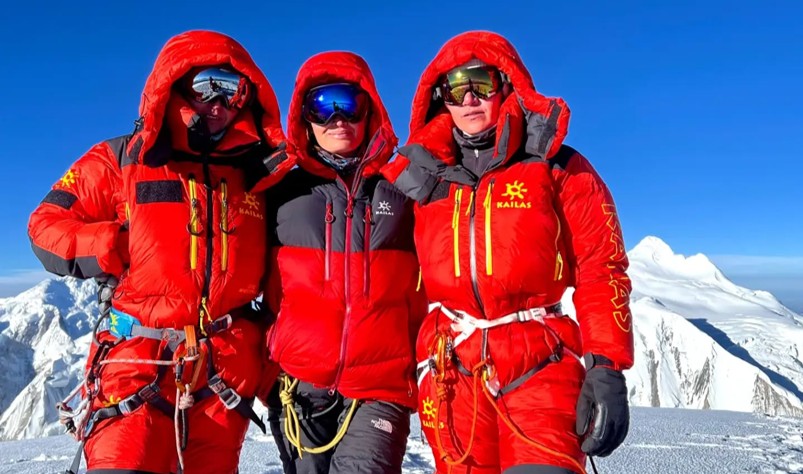
In the remote Karakoram range of northern Pakistan, four women from Gilgit-Baltistan quietly rewrote a chapter of mountaineering history.
They reached the summit of 7,027-meter Spantik Peak — known locally as Golden Peak — without the help of high-altitude porters, then returned safely to Skardu.
The achievement, confirmed by the Alpine Club of Pakistan, stands out not only for its technical demands and courage but for what it represents in a region where women climbers have long navigated cultural barriers as steep as the mountains themselves.
A Clean Ascent in Difficult Conditions
Spantik rises in Shigar District, its northwest face marked by a striking golden marble pillar that gives the peak its nickname. The standard route involves multi-day approaches across glaciers, fixed lines on steeper sections, and the usual high-altitude risks of cold, thin air, and sudden weather shifts.
According to Alpine Club of Pakistan General Secretary Ayaz Shigri, the four local women reached the top in the days around August 20–21, 2026, and were back in Skardu by the following Monday. They carried their own loads at altitude — a notable step for climbers from the region, where high-altitude porters traditionally handle much of the heavy work above base camp.
Weather windows were short in a season that has tested the bravest of climbers and taken away many seasoned climbers including a legendary Nepalese mountaineer and an American dream chaser.
Fortunately for the all-women expedition, conditions remained favorable after days of scary deterioration with rain, snow, and wind, complicating other operations on the mountain at the same time.
The Climbers with a Mission
The successful team members were:
– Shama Baqir and Samana Rahim, both from Shimshal Valley
– Zooni Aslam (also referred to as Bibi Afzoon or Zoni), from Gulmit Valley in Gojal, Upper Hunza
– Zaiba Batool Shigri, from Shigar District
Shimshal has produced a steady stream of skilled climbers over the years, many of them from families with deep roots in the high pastures and glacier approaches. Shigar and Hunza have likewise seen rising numbers of local women training and guiding. Zaiba Batool Shigri’s summit marked another first for women from her home valley on a peak of this height.
Bismah Hassan of Lahore was part of the broader group but turned back roughly 250 meters below the summit after experiencing a health issue, according to multiple reports including ProPakistani.
“This summit is much more than a personal achievement for me. It is a celebration of the strength, unity, courage, and power of women,” Samana Rahim wrote in a social media post after achieving the feat.
“I climbed Spantik with a message close to my heart, to raise awareness about climate change and the challenges our mountains are facing. We made a commitment to leave nothing behind except our footprints, and we carried all our trash back with us. Our mountains give us so much, it is our responsibility to protect them.”
Other Summits on the Same Mountain
The same period saw additional notable climbs. Romanian climber Alexandra Visan, who has been battling cancer, reached the summit and descended safely. Her expedition was organized by Broad Boy Adventures, the company founded by Pakistani mountaineer Shehroze Kashif.
Visan was accompanied by local high-altitude porter Ali Ameen of Shigar. Kashif described her climb as a story of perseverance, noting that some mountains are climbed not only against rock and ice but against the limits of the body itself.
Punjab climber Ayyan Adeel also stood on the summit. Kashif said Adeel became the youngest climber to reach the top of Spantik without high-altitude porter support, carrying his own equipment with help from fellow team members Awais Choudary and Talha Khalid.
Bismah Hassan described the the summit as a “huge success for the entire team, as we have been planning to attempt Spantik for the last year.”
“It required a year-long plan and practice, which included ice climbing training sessions in March, and attempts on 5000m and 6000m peaks earlier this year to prepare ourselves for Spantik Peak – 7027m,” she wrote in a Facebook post.
A Tragedy Parallel to Success
While these summits were being celebrated, recovery teams were struggling with a separate and grim task. Dr. Asma Mushtaq, a 34-year-old Pakistani doctor specializing in obstetrics and gynecologist who worked in the United Kingdom and was originally from Lahore, successfully reached the summit of Spantik on or around August 20.
During the descent, at approximately 6,400 meters, she suffered a severe high-altitude medical emergency and died despite efforts by her guides.
Her body remained at Camp 3 for days as heavy snow, rain, and high winds forced rescue teams to turn back repeatedly. Alpine Club officials and local authorities coordinated recovery attempts, prioritizing the safety of the rescuers. Later reports indicated teams reached the suspected location but faced further complications locating the body under fresh snow.
The Alpine Club of Pakistan stated that the circumstances of the death and the response of the expedition company would be investigated once all teams were safely down and the body recovered.
Why This Climb Matters
Spantik is not among the world’s 8,000-meter giants, yet it remains a serious high-altitude objective. The first Pakistani woman to summit it was Uzma Yousaf in 2017, an achievement that opened a path for others.
In the years since, more women from Gilgit-Baltistan valleys have trained, guided, and climbed, often balancing traditional community expectations with the physical and logistical demands of the mountains.
Climbing without high-altitude porters raises the physical bar. It also shifts the narrative: these women moved under their own power on a peak that sits deep in the landscape their communities have lived with for generations.
The stories of Everest or Denali, Spantik may be less familiar. Yet the Karakoram holds some of the most dramatic terrain on Earth, and the quiet competence of local climbers — especially women from villages that once saw mountaineering as almost exclusively male — is changing who gets to stand on these summits and how the stories are told.
The four women from Shimshal, Gulmit, and Shigar have added a clear, verifiable line to that record. They reached the top, came down safely, and did it without the usual high-altitude support system. In the high valleys of Gilgit-Baltistan, often experiencing Nature’s daunting vicissitudes that is no small feat.

Kiran Asim is a writer who covers the U.S., Europe, South Asia, and the Middle East. Her reports and analyses look at the geostrategic issues and contemporary developments and their economic and political implications. She also writes about society and education.