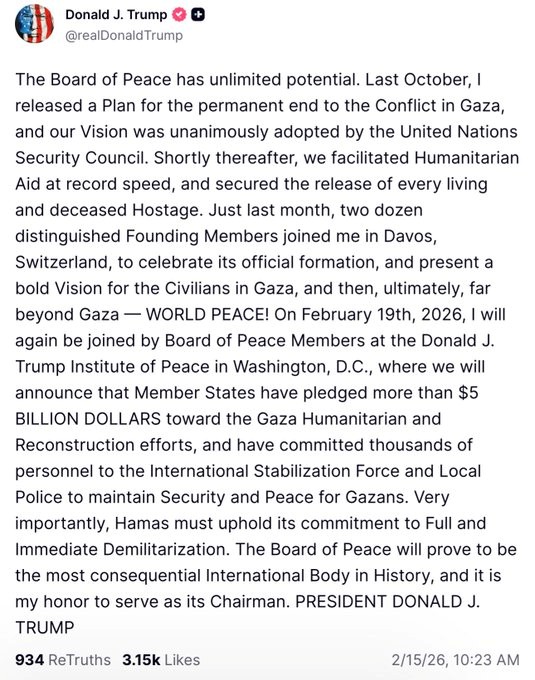
Ahead of this week’s meeting of the Board of Peace, President Donald Trump has revealed that members of his newly established U.S.-led body have pledged $5 billion for the reconstruction of Gaza and committed thousands of personnel to support an international stabilization and policing mission in the war-torn territory.
The formal commitment to contributions is expected to be unveiled at the board’s inaugural meeting in Washington on Thursday.
In a social media post, Trump described the initiative as potentially “the most consequential International Body in History,” adding that he would serve as its chairman.
Trump’s Gaza Board of Peace to Hold First Meeting on February 19
While Trump did not identify the countries making financial or troop commitments, Indonesia signaled concrete support. The Indonesian military said up to 8,000 troops could be ready by the end of June for possible deployment to Gaza as part of a humanitarian and peacekeeping mission — marking the first firm public commitment to the effort.
Rebuilding the Palestinian Gaza Strip is projected to be an immense undertaking. Estimates from the United Nations, World Bank and European Union place reconstruction costs at roughly $70 billion, following more than two years of devastating Israeli bombardment that left much of the territory shattered.
Pakistan, whose prime minister Shehbaz Sharif will also attend the Board meeting, has not yet announced its commitment but contributing troops is a sensitive issue in the country. Pakistan is a founding member of the forum.
Pakistan Pledges Engagement as Trump Invites It to Join Gaza Peace Board
The UN-endorsed Board initiative is tied to an Oct. 10 U.S.-brokered ceasefire between Israel and Hamas aimed at ending the prolonged conflict.
The agreement mandated the creation of an armed international stabilization force which is to be tasked with maintaining security and ensuring the disarmament of Palestinian militant organization Hamas — a key demand of Israel.
So far, few countries have publicly expressed interest in joining such a force, and Thursday’s meeting might make things clear in terms of individual commitments.
It is unclear at the moment as to how many of the board’s more than 20 members will attend Thursday’s meeting. Israeli Prime Minister Benjamin Netanyahu, who met with Trump at the White House last week, is not expected to participate.
Initially the Board was viewed as a mechanism to help resolve the Israel-Hamas war. However, some foreign policy experts suggest that the Board of Peace may reflect Trump’s broader ambition to address global conflicts and potentially reshape the international order.
The move has also drawn skepticism if it could sidestep traditional institutions such as the United Nations Security Council.
Thursday’s gathering will be held at the U.S. Institute of Peace, recently renamed the Donald J. Trump U.S. Institute of Peace by the State Department.
Although, the U.S.-mediated ceasefire has held in the Middle East, Israel has bombed the area several times.
Meanwhile, the United Nations alleged humanitarian agencies in the Gaza Strip continue to face impediments in their efforts to deliver lifesaving aid to the suffering population but they have continued with their efforts to take aid to the affected people.
At the UN Headquarters in New York, UN Spokesperson Stephane Dujarric noted that four months have passed since the ceasefire agreement came into effect in Gaza, and the humanitarian scale-up has saved countless lives and pushed back famine.

Iftikhar Ali is a veteran Pakistani journalist, former president of UN Correspondents Association, and a recipient of the Pride of Performance civil award