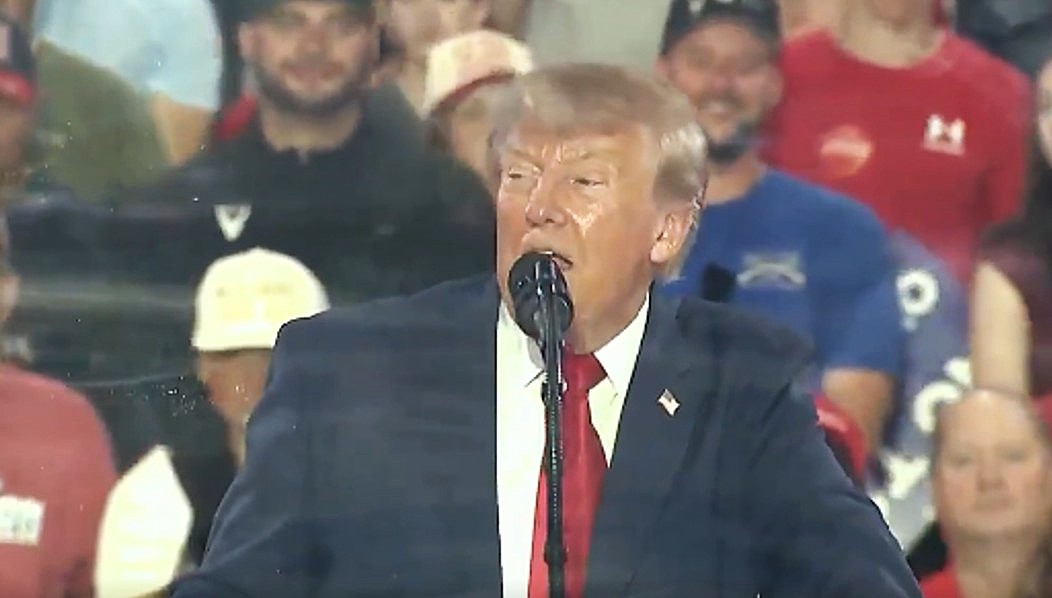
President Donald Trump has revived the prospect of seeking another term in the White House, arguing that his claim of having won the 2020 election gives him grounds to run again, even as he acknowledged that the U.S. Constitution’s language on presidential term limits leaves little room for interpretation.
Trump’s floated the idea in a speech to a campaign rally in Iowa ahead of the November 3 midterm elections.
Initially appeared to concede that he could not seek the presidency for a third time. He then invoked his repeated, unsubstantiated allegations that the 2020 election was stolen to challenge that conclusion.
“I don’t know who’s going to be your next president,” Trump told the audience, before adding that he believed the law prohibited him from running again, although he was “not 100 percent sure.”
President Trump on the idea of running for a third term: “I think I have the right to run again, because they cheated.” https://t.co/dmyyL429zx
— CSPAN (@cspan) October 23, 2026
The president then described the relevant constitutional wording as unusually difficult to contest.
“I’ve studied that phrase forever,” he said. “Unfortunately, it’s quite concise. There’s not a lot of wiggle room.”
Trump nevertheless argued that his disputed account of the 2020 election should entitle him to another campaign.
“They cheated us on the second one because we won it three times, so I think I have the right to run again,” he said.
“I think I have the right to run again because they cheated.”
“They rigged the election. They rigged that,” he added.
Related:
Trump says ‘not joking’ about third term, there are methods but focused on the current
Trump did not explain how the alleged election fraud would alter the constitutional limit. He lost the 2020 election to Democrat Joe Biden, and no evidence has established that fraud changed the result.
The 22nd Amendment to the U.S. Constitution provides that no person may be elected president more than twice. Ratified in 1951, it established the limit following Franklin D. Roosevelt’s four election victories.
Trump was elected in 2016 and returned to office after winning the 2024 election. Under the amendment’s text, he has therefore reached the limit on presidential elections.
The amendment contains no exception for a president who disputes the result of an earlier election. Trump’s remarks did not identify a legal mechanism through which his allegations about 2020 could overcome the restriction.
His comments nonetheless extend a recurring theme in his public appearances: the suggestion that he might seek to remain in power beyond the end of his current term in January 2029.

Muhammad Luqman is Associate Editor at Views News Now. He writes on wide-ranging issues including economy, South Asia, the Middle East, agriculture, economy and innovation. Luqman has worked some of the leading news organizations and won acclaim for his original and research-based works.