Pakistan has signaled its willingness to expand its historic new defense pact with Saudi Arabia to include other Arab nations, potentially reshaping regional security cooperation.
Defense Minister Khawaja Asif said Thursday that “doors are not closed” for additional Arab states that might want to join the newly signed Strategic Mutual Defense Agreement.
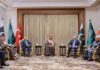
The pact was formalized a day earlier during Prime Minister Shehbaz Sharif’s visit to Riyadh, where he and Saudi Crown Prince Mohammed bin Salman signed the agreement at Al-Yamamah Palace.
Riyadh has celebrated the agreement as a landmark move to ensure its defense against any hostile attacks.
In momentous development, Saudi Arabia and Pakistan sign defense pact
Under the agreement, any act of aggression against either country will be treated as an attack on both, marking a significant deepening of military ties between the two allies.
“I cannot prematurely answer this, but I will definitely say the doors are not closed,” Asif said in an interview on Geo News.
He emphasized that the agreement is defensive, not aggressive, and drew comparisons to NATO’s collective defense mechanism.
“It is the fundamental right of countries and people in this region — particularly the Muslim population — to defend their nations together,” he said.
When asked whether the pact includes the use of Pakistan’s nuclear capabilities, Asif responded:
“What we have — our capabilities — will absolutely be available under this pact.”
The Islamic Republic of Pakistan and The Kingdom of Saudi Arabia have signed a Historic Strategic Mutual Defence Agreement (SMDA)
Building on the historic partnership extending for nearly eight decades, based on the bonds of brotherhood and Islamic solidarity, as well as shared… pic.twitter.com/9z8iBwKTkQ
— Government of Pakistan (@GovtofPakistan) September 17, 2025
However, he stressed that Pakistan remains a responsible nuclear power:
“Since becoming a nuclear state, Pakistan has never been challenged on its responsible behavior. We’ve always allowed inspection of our nuclear facilities — unlike Israel.”
The minister clarified that the agreement does not name or target any specific country but rather serves as a joint response framework in the event of aggression from any source.
“It is an umbrella agreement. If there is aggression against either side — from any side — it will be jointly defended and responded to.”
Asif also highlighted Pakistan’s longstanding military cooperation with Saudi Arabia, including training programs, describing the new pact as a formal extension of decades of collaboration.
The agreement between Saudi Arabia comes amid growing security concerns in the wake of Israel’s strike in Qatar, a peaceful U.S. ally. which was also brokering negotiations for a ceasefire deal between Israel and Palestinian militant Hamas organization Hamas.
The prolonged Gaza conflict threatens to
Follow for more: Twitter (X) | Facebook | Instagram | LinkeIn

Kiran Asim is a writer who covers the U.S., Europe, South Asia, and the Middle East. Her reports and analyses look at the geostrategic issues and contemporary developments and their economic and political implications. She also writes about society and education.