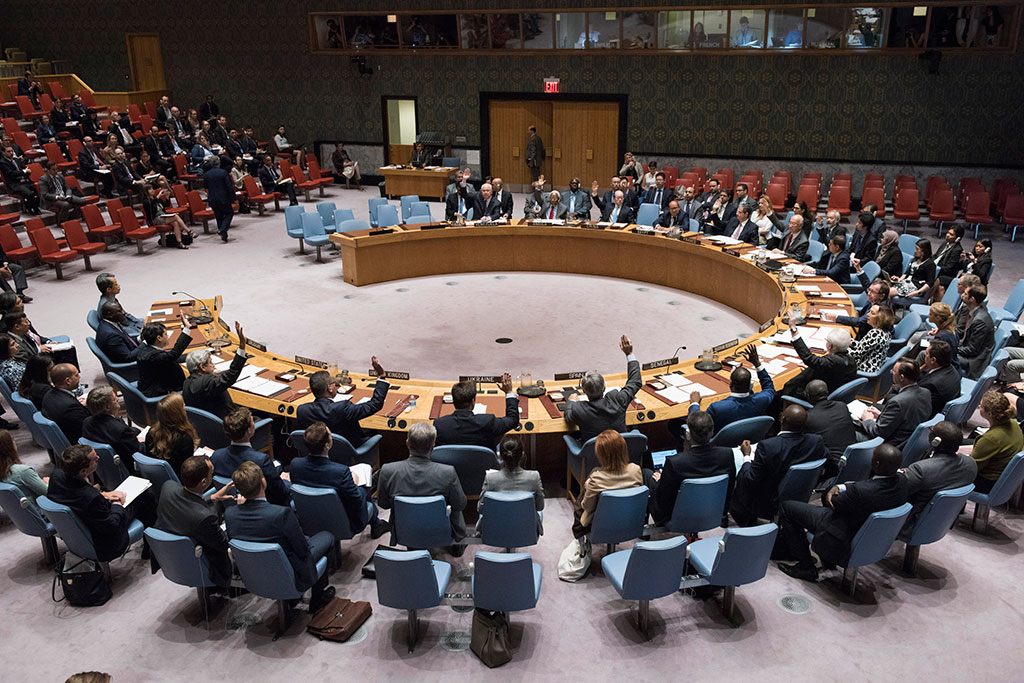
The UN Security Council resolutions, pledging the right of self-determination to the people of Kashmir have “not changed,” UN Deputy Spokesperson Farhan Aziz Haq said Wednesday.
The spokesperson was responding to a question about India’s unilateral decision to revoke the special autonomous status of Jammu and Kashmir in 2019.
“You are certainly aware of the Security Council’s resolutions dating back to 1949 concerning the status of Kashmir, and those resolutions have not changed,” Haq told reporters at the world body’s headquarters in New York.
The spokesperson noted that the UN remains concerned about human rights in the region.
“Regarding our concerns,” he said, referring to recent statements by UN High Commissioner for Human Rights Volker Turk, “all basic rights are respected for the people of Kashmir.”
Kashmir is a UN-recognized disputed territory in the Himalayan mountains, divided between India and Pakistan by a Line of Control. August 5 marks the anniversary of the Indian government’s 2019 decision to revoke the territory’s special constitutional status, a move that Pakistan and local opposition parties strongly oppose.
Islamabad continues to regard the territory as disputed in line with UN resolutions, despite decades of deadly insurgency and security operations in the region.
Kashmir has been a nuclear flashpoint for decades, with the two countries having fought several full-blown wars over the territory. The dispute is also seen as a lightning rod for militancy.
Meanwhile, Pakistan’s UN Ambassador Asim Iftikhar Ahmad used a Security Council debate on terrorism to condemn India’s actions, calling the 2019 annexation—carried out with 90,000 troops—the “worst example of state terrorism.”
“On this day… the Kashmiri people, enduring over seven decades of injustice, indignity, unfulfilled promises and denial of their Security Council-guaranteed fundamental right to self-determination were subjected to a new wave of repression,” Ahmad said. He urged the international community not to allow “counter-terrorism to be misused and abused as a pretext to suppress the internationally-recognized and legitimate struggles of peoples against foreign occupation.”
India maintains that Jammu and Kashmir is an integral part of its territory and rejects any third-party mediation or calls for a UN-supervised plebiscite.
New Delhi has defended its 2019 decision as a necessary measure to curb separatism and spur economic development, a stance that remains at odds with Pakistan’s interpretation of the 1949 Security Council resolutions.

Muhammad Luqman is Associate Editor at Views News Now. He writes on wide-ranging issues including economy, South Asia, the Middle East, agriculture, economy and innovation. Luqman has worked some of the leading news organizations and won acclaim for his original and research-based works.