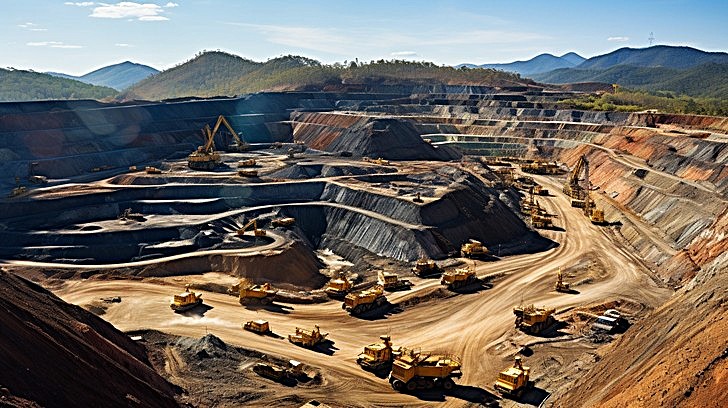
The United States and Pakistan have agreed to expand cooperation in the mining, minerals and energy sectors, reflecting Washington’s efforts to diversify critical mineral supply chains and Islamabad’s push to attract greater foreign investment.
The renewed engagement was discussed during a meeting between U.S. Assistant Secretary of State for South and Central Asian Affairs John Mark Pommersheim and Pakistan’s Interior Minister Mohsin Naqvi.
According to Pakistani government, both sides reaffirmed their commitment to strengthening bilateral relations, with particular emphasis on economic collaboration in strategic sectors.
According to the U.S. Embassy in Islamabad, Deputy Assistant Secretary Pommersheim and Chargé d’Affaires Natalie A. Baker “expressed U.S. appreciation for Pakistan’s partnership in countering terrorism, advancing joint security priorities, and countering illegal migration” during the meeting.”
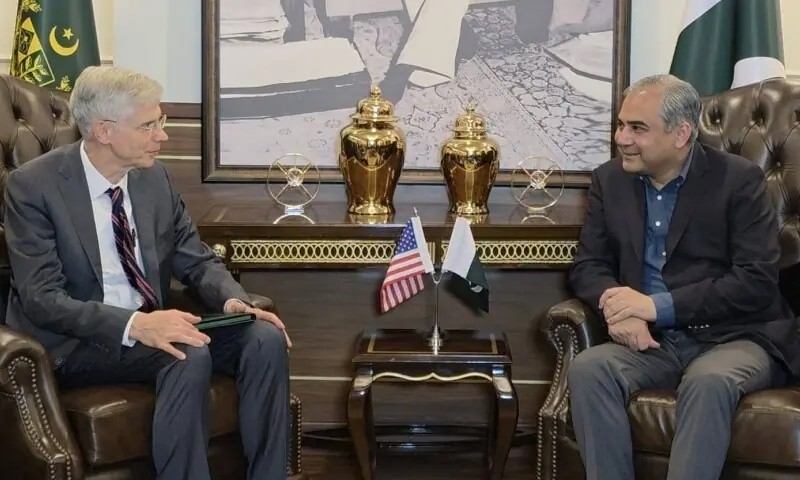
“They pledged to continue cooperation in attracting U.S. investment into Pakistan’s energy sector and to build safe, secure operating environments for U.S. businesses,” the embassy said.
The visiting U.S. official also discussed Pakistan’s economic reforms and financial stability during his meeting with Finance Minister Muhammad Aurangzeb.
The discussed U.S.-Pakistan economic ties promote mutual prosperity via increased bilateral trade and cooperation in key economic sectors.
According to the Interior Ministry, the U.S. official underscored the importance Washington places on its relationship with Islamabad. He also condemned recent terrorist incidents in Islamabad and Quetta and conveyed condolences to the victims.
U.S. Deputy Assistant Secretary John Mark Pommersheim discussed Pakistan’s economic reforms and financial stability during his meeting with Federal Finance Minister Muhammad Aurangzeb. U.S.-Pakistan economic ties promote mutual prosperity via increased bilateral trade and… pic.twitter.com/UUEun2Covw
— U.S. Embassy Islamabad (@usembislamabad) February 11, 2026
Minister Naqvi welcomed prospective U.S. investment in Pakistan’s mining, minerals and energy industries, assuring that American investors would be provided with a secure and supportive environment.
He stressed that international cooperation remains essential in combating terrorism and described Pakistan’s partnership with the United States as important for regional stability and internal security.
The talks also covered broader regional developments and enhanced counterterrorism cooperation.
The United States has long considered Pakistan a key counterterrorism partner in South Asia as it continues to grapple with the challenges of militancy posed by groups operating in the region.
Pakistan seeks US investment, security cooperation as Sharif calls Trump man of peace
The relationship has also expanded to economic areas under the Trump Administration.
The economic focus comes as the United States intensifies efforts to secure reliable access to critical minerals vital for advanced technologies, defense systems and energy production.
In 2025, Pakistani entities signed memoranda of understanding with U.S. companies, including United States Strategic Metals, outlining a framework for cooperation and potential investment in the country’s critical minerals sector.
The projected value of these initiatives has been reported at up to $500 million.
Happy Basant! In Lahore, U.S. Chargé d’Affaires Natalie Baker, Deputy Assistant Secretary John Mark Pommersheim, and Consul General Stetson Sanders joined Lahoris in celebrating the season alongside American businesses that are strengthening commercial ties, setting high… pic.twitter.com/xElX2G3LjB
— U.S. Consulate General Lahore (@USCGLahore) February 11, 2026
As part of this cooperation, Pakistan shipped its first consignment of mineral samples — including rare earth elements and other critical materials — to the United States late last year.
President Donald Trump has repeatedly emphasized the strategic importance of securing supply chains for rare earth and other critical minerals, describing them as essential to U.S. national security, defense manufacturing and emerging technologies. His administration has prioritized partnerships with trusted nations to reduce reliance on concentrated global suppliers and strengthen domestic and allied production capacity.
Pakistan also participated in the inaugural Critical Minerals Ministerial hosted by the U.S. State Department, joining more than 50 countries in discussions aimed at strengthening global supply chains and building strategic partnerships in the sector.
Separately, the United States has launched “Project Vault,” a national initiative designed to build a strategic stockpile of critical minerals and strengthen supply security through cooperation with trusted partners. While not specific to Pakistan, the initiative underscores Washington’s broader strategy to reduce supply chain vulnerabilities and ensure stable access to essential materials.

Muhammad Luqman is Associate Editor at Views News Now. He writes on wide-ranging issues including economy, South Asia, the Middle East, agriculture, economy and innovation. Luqman has worked some of the leading news organizations and won acclaim for his original and research-based works.

Kiran Asim is a writer who covers the U.S., Europe, South Asia, and the Middle East. Her reports and analyses look at the geostrategic issues and contemporary developments and their economic and political implications. She also writes about society and education.